
The scent of fried dough, sweet ricotta, and crushed pistachios was the heartbeat of Little Italy. For sixty years, Rossi & Sons Bakery stood as the neighborhood’s undisputed crown jewel. People queued around the block before sunrise just to bite into one of their legendary cannoli—crisp, blistered shells that shattered into rich, orange-zested cream. The secret was guarded in a heavy iron vault behind the counter, written in faded fountain pen by Nonna Rossi herself in 1952.
To twenty-eight-year-old Sophia Rossi, the bakery was a sacred trust. She had spent her youth dusting flour off her apron, perfecting the delicate fold of the dough alongside her father.
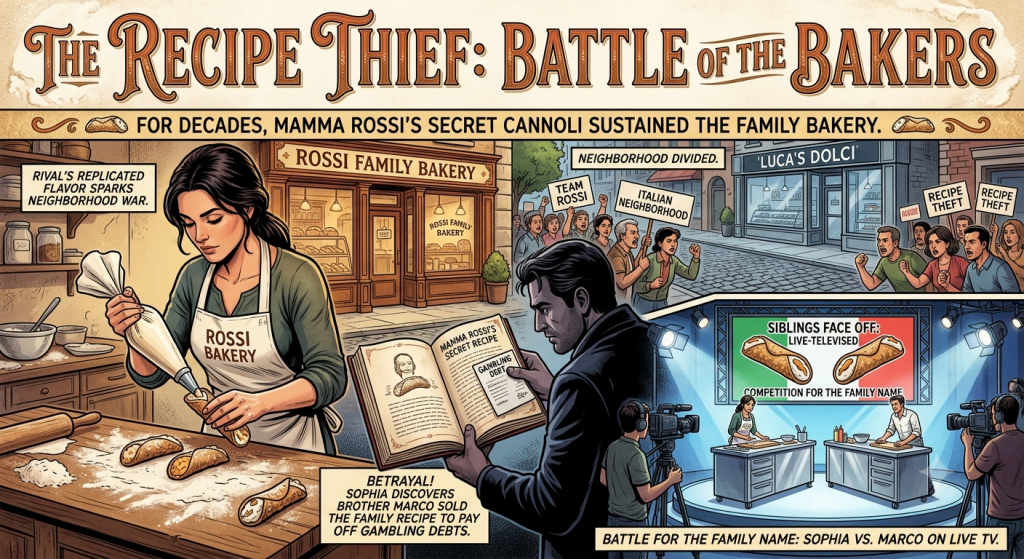
Then came Il Paradiso.
It opened on a Tuesday, directly across the narrow cobblestone street. Its glass storefront was gleaming, modern, and backed by sleek brass fixtures. But it wasn’t the décor that threatened to tear the neighborhood apart—it was their signature pastry.
When Sophia bought one out of curiosity, her world shattered. The blister on the shell, the hint of wild clover honey, the subtle undertone of dark rum in the cream—it wasn’t just similar. It was an exact, line-for-line duplicate of Nonna’s secret recipe.
Within forty-eight hours, the street erupted into chaos. Loyal customers took sides, shouting matches broke out along the sidewalk, and old men argued furiously over espresso cups. The press dubbed it “The Great Cannoli War.”
Sophia raged against the rival owner, demanding to know who leaked the blueprint. She suspected disgruntled former apprentices, corrupt vendors, even corporate espionage.
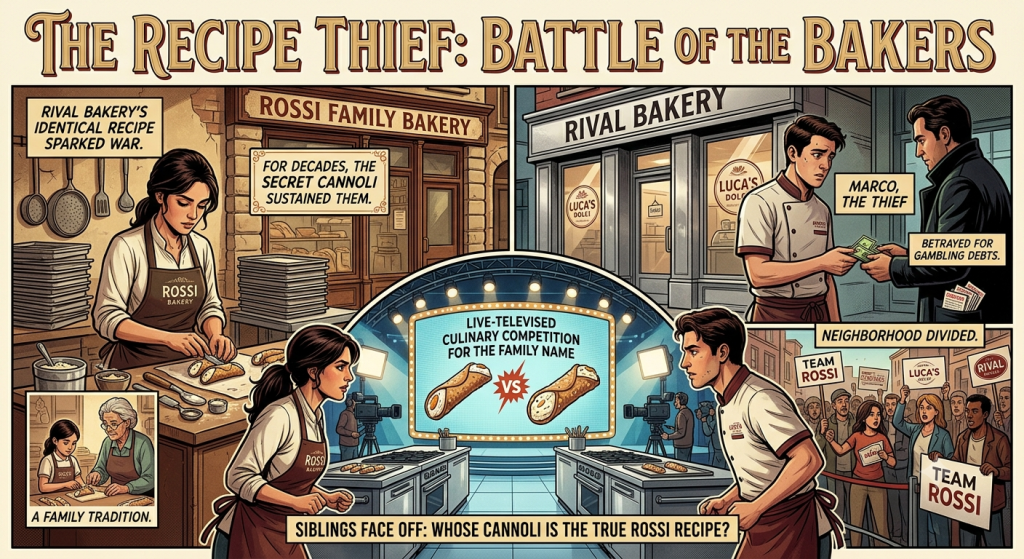
She never suspected her older brother, Marco.
The truth revealed itself on a rainy Thursday night. Sophia was auditing the bakery’s flour inventory in the basement when she overheard quiet, frantic voices near the alley door. She crept toward the shadows and saw Marco handing a heavy envelope of cash to a man with sharp suits and broken knuckles.
“That’s the last of the thirty grand,” the man grunted, counting the bills. “Your debts are clear, Rossi. The guys at Il Paradiso are very happy with their new menu.”
Sophia’s breath hitched. The air rushed out of her lungs as if she’d been struck with a rolling pin.
When the man left, Marco turned around—only to freeze in the harsh light of the alley lamp. Sophia was standing in the doorway, tears streaming through the flour dust on her cheeks.
“You sold Nonna,” she whispered, her voice trembling with a mixture of agony and rage. “You sold sixty years of our family’s sweat to pay off your card games?”
Marco flinched, looking down at his boots. “Sophia, please… you don’t understand the people I owed money to! They were going to break my hands. I didn’t have a choice!”
“You had a thousand choices!” Sophia yelled, her voice echoing down the narrow alley. “You sacrificed our father’s legacy to save your own skin!”
The news of the internal betrayal fractured the Rossi family completely. Their father, heartbroken, suffered a mild stroke and was forced to step down, leaving Sophia at the helm of a sinking ship. Il Paradiso launched a massive advertising blitz, claiming they possessed the authentic Italian taste, undercutting Rossi’s prices and stealing half their clientele.
The feud reached a boiling point when The Culinary Clash, a hit nationwide live-television show, descended upon Little Italy. Spotting a goldmine of drama, the producers offered a challenge: a live, three-round baking duel between Rossi & Sons and Il Paradiso.
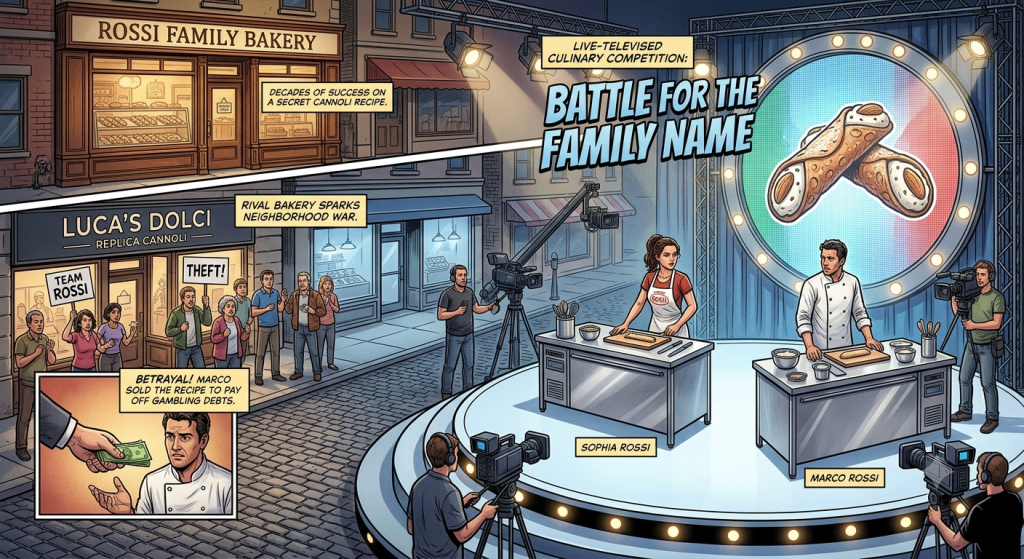
The winner would receive a $100,000 grand prize and the official title of “Master of the Quarter.” The loser would agree to close their doors forever and surrender their business license.
Against her father’s pleas to avoid the spectacle, Sophia accepted. Marco, now officially employed as the head pastry chef at Il Paradiso, was forced onto the stage by his new corporate bosses.
On the day of the broadcast, the street was shut down. Giant screens were erected on the sidewalk, and thousands of locals crammed against the police barricades, waving red, white, and green flags.
Inside the mobile studio, under the blistering white studio lights, two identical baking stations faced each other.
“Three! Two! One! Bake!” the host shouted.
For ninety minutes, the air filled with the roar of deep fryers and the whir of commercial mixers.
Across the aisle, Marco worked with frantic, mechanical precision. He knew Nonna’s recipe by heart; he was executing it perfectly, measuring the precise grams of sheep’s milk ricotta, dark chocolate bits, and candied orange peel. He looked at Sophia, expecting to see her copying the same steps.
Instead, Sophia was doing something entirely different.
She wasn’t using sheep’s milk. She had brought a tub of fresh, local goat’s milk ricotta from a small farm upstate. She wasn’t using rum; she was infusing the cream with a splash of homemade fig liqueur her grandmother used to brew for Christmas.
Marco stared at her in shock. She’s abandoning the recipe! he thought. She’s insane.
Sophia’s hands flew with practiced, graceful memory. She remembered sitting on a wooden stool at seven years old, watching Nonna cook. Nonna had always told her: “The recipe isn’t the paper, Sophia. The paper is just a map. The soul is knowing when to change course.”
Nonna’s written recipe had been tailored for the ingredients of 1952. But Sophia wasn’t just baking a pastry—she was telling a story of survival.
“Ten seconds!” the host bellowed.
Sophia piped the final star-shaped dollop of cream into her blistered shell, topping it with crushed roasted pistachios and a single, glinting leaf of edible gold foil.
The clock hit zero. The crowd outside cheered wildly.
The three celebrity judges—renowned pastry chefs from Rome, Paris, and New York—sat at a long wooden table.
First came Il Paradiso. They tasted Marco’s cannoli.
“Technically flawless,” the Italian judge declared, wiping his mouth with a napkin. “The classic recipe. Crispy shell, classic rich ricotta, hints of orange. It is the gold standard of Little Italy.”
Marco exhaled a long breath, casting a triumphant look toward his sister.
Then, the judges turned to Sophia’s plate.
The French judge picked up the cannoli, admiring the deep, golden blister pattern on the crust. She took a bite. The sound of the shell breaking echoed through the studio microphones like a crisp twig snapping.
Silence stretched across the room. Five seconds. Ten seconds.
The Italian judge closed his eyes, his hands resting on the table. When he opened them, there were tears in the corners of his eyelids.
“This…” the judge whispered, his voice trembling slightly. “This is not just a classic cannoli. The fig liqueur cuts the heaviness of the cream. The goat’s milk brings an earthy complexity that elevates the sweet shell. It tastes like… it tastes like autumn in Sicily.”
The New York judge slammed his hand on the desk. “It’s a masterpiece. It takes the past, honors it, and completely redefines the future.”
The host stepped forward, holding the golden envelope. “The judges have reached a unanimous verdict. The winner… and remaining undisputed king of Little Italy… is Rossi & Sons Bakery!“
The studio audience exploded. Outside, the neighborhood erupted into a deafening roar of sirens, cheers, and clinking glasses.
Sophia sank onto her workbench, buried her face in her hands, and wept—not just from victory, but from pure, exhausting relief.
As the television cameras swarmed around Sophia, Marco stood alone in his sleek, corporate kitchen station. The owners of Il Paradiso were already packing up their gear, cursing under their breath and tossing their aprons onto the floor. Marco’s contract was void. His reputation was shattered.
He slowly walked across the stage floor toward his sister. The security guards moved to block him, but Sophia raised a hand, stopping them.
Brother and sister stood two feet apart amid the confetti and flashbulbs.
“You beat Nonna’s recipe,” Marco said softly, his voice barely audible over the noise. “I didn’t think anyone could do that.”
“I didn’t beat Nonna,” Sophia replied, her eyes steady, hard, but no longer filled with hatred. “I just grew up. You kept trying to sell the past, Marco. I decided to build tomorrow.”
Marco looked down at his trembling hands—the hands of a baker who had lost his way. “What do I do now, Soph?”
Sophia looked out toward the crowd, where their father was being helped through the doors, tears streaming down his face as he smiled at her. She reached into her apron pocket, pulled out the faded, yellowed paper of Nonna’s 1952 recipe—the paper Marco had stolen—and handed it back to him.
“You’re going to pay off your debts,” Sophia said, her tone absolute and unyielding. “You’re going to work in our basement, washing dishes and sacking flour for three years. And maybe… just maybe… one day I’ll teach you how to make the new recipe.”
Marco stared at the paper in his hands, tears slipping onto the ink. He nodded slowly, taking his first step back onto the long road home.

0 comments