
Chapter 1: The Glass Wall
The glass partition between the East Wing and West Wing of the Chen Medical Building was more than a structural choice; it was a border between two distinct eras of medicine.
On the West Wing, Dr. Robert Chen moved with clockwork precision. His side of the practice featured polished slate floors, quiet air filtration units, and state-of-the-art diagnostic bays. Every consultation was capped at twelve minutes. Every diagnosis was backed by high-resolution imaging and double-blind clinical trials. To Robert, medicine was an exact science—a complex equation of biomechanics where emotional sentiment was merely a variable that compromised efficiency.
On the East Wing, the scent of dried chamomile, lavender, and steaming willow bark tea drifted through the corridor. Dr. Joy Chen sat on a low stool beside an elderly patient, listening intently not just to the woman’s lungs, but to her life story. Joy’s practice prioritized acupuncture, botanical formulations, stress management, and deep community integration. She believed that healing required treating the whole person within their environment, a philosophy her father often dismissed as gentle hand-holding.
“Joy, your schedule is thirty minutes behind,” Robert said, stepping into her sunlit office at the end of the afternoon. He tapped his digital tablet. “Efficiency isn’t just about revenue; it’s about patient volume. If you don’t triage effectively, people wait.”
Joy smiled softly, offering him a ceramic cup of hot tea, which he politely declined. “Mrs. Gable didn’t need another prescription for her blood pressure, Dad. She needed someone to help her process the grief of losing her husband. Her heart rate settled twenty points the moment we talked through her routine.”
“Anecdotal,” Robert replied dryly. “Biometrics respond to biochemistry, Joy. Sentiment doesn’t clear arterial blockages.”
“And clinical coldness doesn’t build trust,” Joy countered gently.
It was an argument they had refined over five years, ever since Joy returned from her fellowship in integrative medicine to join her father’s established practice. They loved each other deeply, yet their professional convictions stood like an unyielding wall between them.
That wall crumbled on a Tuesday in early autumn.
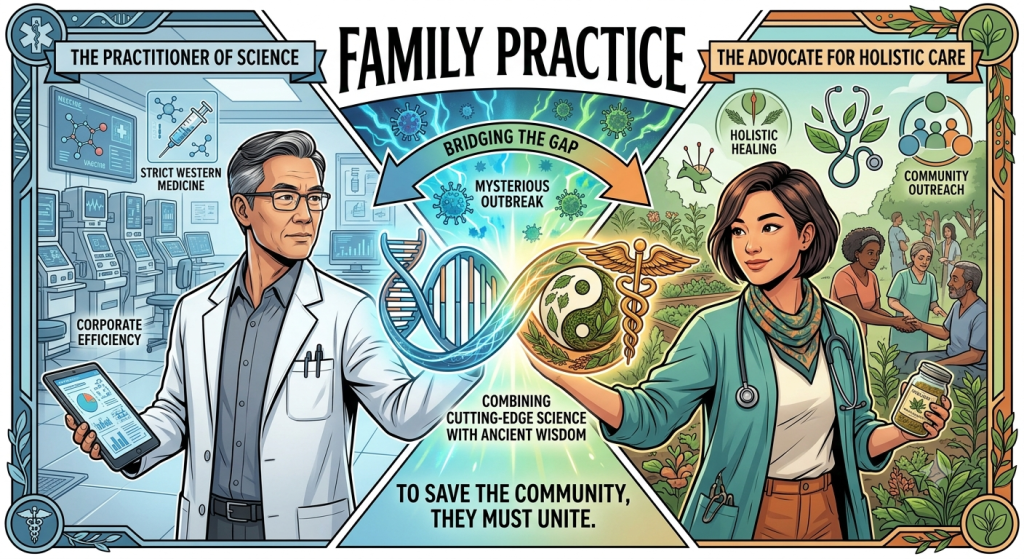
Chapter 2: The Shadow in the Valley
It began with a single frantic father carrying his ten-year-old daughter into the clinic’s reception area. The girl was burning with a fever of 104 degrees, her breathing shallow and raspy. Most alarmingly, fine, thread-like blue lines were visible beneath the translucent skin of her wrists and neck—a rapid cyanotic discoloration indicative of micro-vascular inflammation.
Within three hours, six more residents of the small valley town presented identical symptoms. By midnight, the local twenty-bed hospital was overwhelmed.
Robert immediately took command of the emergency response. He quarantined the West Wing, establishing a clean room environment. He ordered full-panel pathogen screens, high-resolution chest CTs, and broad-spectrum intravenous antivirals.
“The pathogen causes acute cytokine storms combined with rapid systemic vascular clotting,” Robert stated, studying the digital blood panels on his multi-monitor display. His eyes were dark with fatigue. “Standard broad-spectrum agents are failing to slow the viral replication. The cellular envelope of this strain is unusually resistant.”
“It’s moving too fast,” Joy said, looking over his shoulder at the microscopic scans. “Look at the cellular uptake. The virus uses specific protein pathways to bypass the cell membrane, triggering severe oxidative stress before the immune system can even respond.”
“We need a targeted protease inhibitor,” Robert muttered, his hands hovering over his keyboard. “I’ve sent the genetic sequence to the state laboratory, but a custom pharmaceutical synthesis will take weeks. These patients don’t have forty-eight hours.”
Joy walked to the window, looking out over the quiet town framed by the autumn-clad hills. “Dad, where did the first patients come from?”
“The north side of the valley, near the old timber mill,” Robert said without looking up.
“That’s where the old creek runs,” Joy mused. “The dry summer exposed the root systems of the ancient black elder and sweet gale along the riverbeds. The locals harvest wild mushrooms and herbs there every autumn. If this pathogen is environmental, the local ecosystem might already hold the biochemical key to counteracting its stress response.”
Robert paused, looking up at his daughter with a mixture of skepticism and desperation. “Joy, this is an aggressive, novel bio-pathogen. A cup of herbal tea isn’t going to stop micro-vascular necrosis.”
“I’m not talking about tea, Dad,” Joy said firmly. “I’m talking about biochemistry. Plants produce potent defense molecules—flavonoids and polyphenols—specifically to neutralize vascular toxins and cellular invasion. You have the laboratory equipment to isolate compounds. I know which botanical structures target these exact vascular pathways. Let me help you.”
Robert looked at the digital monitor displaying the dropping oxygen saturation levels of his critical patients. The cold certainty of his protocols had yielded no answers.
“Show me,” he said.
Chapter 3: Convergence
For the next eighteen hours, the glass partition between the wings vanished.
Joy led a team of local volunteers into the valley, collecting samples of specific indigenous flora—concentrated harvests of high-potency elderberry bark, wild skullcap, and sweet birch, which contained natural precursors to anti-inflammatory and antiviral compounds.
Back in the West Wing’s advanced laboratory, Robert shifted his machinery from analyzing synthetic pharmaceuticals to running high-performance liquid chromatography on Joy’s botanical extracts.
“Fascinating,” Robert murmured, watching the spectral analysis render on his screen. “The concentrated bioflavonoid compound in this extract… it binds precisely to the docking site of the viral protein. It acts as a physical shield around the vascular endothelial cells.”
“It stops the virus from entering the cell,” Joy explained, adjusting the temperature on a distillation apparatus. “While the natural salicylic compounds calm the cytokine reaction in the blood vessels.”
“However,” Robert pointed out, pointing his pen at the screen, “raw botanical extract absorbed through the digestive tract won’t achieve the plasma concentration required to halt the systemic spread in time. The bioavailability is too slow.”
“Then we adapt your method,” Joy said, meeting his eyes. “We refine and isolate the active compound, stabilize it in a saline buffer, and introduce it intravenously using your micro-dosing protocol.”
Together, father and daughter worked side by side. Robert calibrated the precise molecular weight and dosage parameters, applying rigorous clinical protocols to ensure safety and purity. Joy directed the extraction process, ensuring the delicate synergistic compounds within the plant matrix were preserved rather than destroyed by chemical synthesis.
By dawn, they had produced fifty vials of a clear, golden tincture stabilized for intravenous administration.
Chapter 4: The Synergist
The first dose was administered to the young girl who had arrived two days prior. Her oxygen levels were critically low, her extremities cool and discolored.
Robert monitored the telemetry, his heart pounding against his ribs in a way no medical textbook had ever prepared him for. Joy stood at the bedside, gently holding the girl’s hand, placing a cool cloth on her forehead and whispering steady, reassuring words.
For twenty agonizing minutes, the monitors beeped in a slow, frightening rhythm. Then, slowly, the baseline shifted.
The thread-like blue lines on the girl’s wrists began to fade as vascular inflammation subsided. Her oxygen saturation numbers climbed—88%, 91%, 95%. Her breathing softened, shifting from labored gasps to a peaceful, steady rhythm.
By noon, as the remaining doses were administered throughout the community clinic and regional hospital, patient after patient showed rapid, dramatic stabilization. The crisis had been halted.
Chapter 5: A New Practice
A month later, the autumn air was crisp and clear over the valley.
The Chen Medical Building looked subtly different. The glass wall dividing the East and West wings had been replaced with an open, timber-framed entryway connecting both sides.
In the central conference room, Dr. Robert Chen sat across from a young medical resident. On the table between them lay both a high-tech diagnostic tablet and a freshly bound ledger of botanical pharmacology.
“Medicine,” Robert explained to the resident, gesturing toward his daughter, who was discussing a post-recovery wellness plan with a patient nearby, “is neither purely a science of cold mechanics nor an art of simple comfort. It is the precise application of truth—wherever that truth is found, whether in a synthetic molecule or an ancient root.”
Joy caught her father’s eye from across the room and smiled. Robert offered a quiet nod in return, picking up his cup of warm willow bark tea, taking a slow sip, and returning to his work.

0 comments